


The Owen Daniels Engineering & Manufacturing Market Update: UK & Midlands Insight | 2026 Outlook

The UK engineering and manufacturing sector continues to evolve in response to global economic pressures, technological innovation, and shifting workforce dynamics.
As we move through 2026, businesses are balancing cautious optimism with strategic investment, particularly in automation, sustainability, and skills development.
This report provides a focused overview of national trends alongside a deeper look into the Midlands and Northern regions, key industrial hubs driving UK productivity.
Market Snapshot (2025 Actuals | 2026 Outlook)
The UK engineering and manufacturing sector enters mid-2026 in a state of "active resilience."
Key Industry Stats
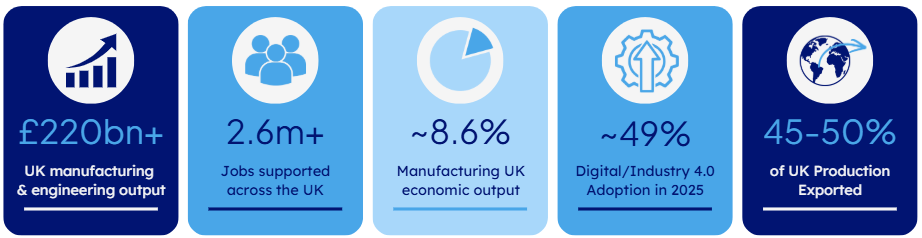
UK Market Demand
- Surging requirement for for offshore wind, grid upgrades, and battery storage.
- Rising global demand driving a peak in manufacturing output.
- Urgent requirement for green steel and composites in fusion and EVs.
UK Manufacturing Output
- Output rising steadily, led by strong recoveries in automotive and aerospace.
- Electronics and high-tech manufacturing are significantly outperforming basic goods.
- Increased automation and AI adoption are boosting volume despite high costs.
The Midlands Perspective
The Midlands remains the core of UK manufacturing and engineering.
The region employs approximately 120k people in manufacturing and engineering roles, representing over 40% of the UK manufacturing workforce. It produces around 45% of all UK industrial output and generates an estimated £104 billion annually.
Looking ahead, the Midlands is central to future growth:
- £100 Billion + Investment pipeline in energy transition, electrification & advanced materials
- 250k-350k new jobs linked to reshoring, net zero & supply chain localisation by 2035
This positions the Midlands as a key driver of UK manufacturing, innovation, and sustainable growth, supporting net-zero targets, strengthening supply chains, and creating long-term engineering jobs.
Industry Transformation
The net-zero and energy transition agenda is reshaping the UK engineering and manufacturing sector. Significant investment in renewables, hydrogen, nuclear, and electrification is driving technological innovation and regional economic growth, supporting the UK’s carbon reduction goals.
Reshoring and supply chain localisation are also shaping the sector. Post-Brexit trade changes and geopolitical shifts are encouraging UK-based production, strengthening domestic supply chains and boosting long-term resilience and competitiveness.
Government support underpins these changes, with over £4.5 billion in Industrial Strategy funding directed toward advanced manufacturing, semiconductors, and green technology. This investment enables innovation, adoption of cutting-edge technologies, and positions the UK as a leader in high-value, future-focused manufacturing.
Workforce & Employment Insight
The most significant transformation in the UK engineering and manufacturing sector is occurring within the workforce itself. Companies are adapting to technological change, automation, and digitalisation, reshaping the skills required across roles.
Currently, the sector faces around 190,000 vacancies, reflecting a skills-constrained environment rather than a lack of demand. This equates to an effective vacancy rate of 36%, highlighting the ongoing challenges employers face in filling critical positions.
To address these gaps, there has been a 5% increase in apprenticeships and early careers hiring between 2025 and 2026.
Despite these efforts, 76% of businesses report persistent skills shortages, particularly in digital technologies, automation, and systems engineering, underscoring the urgent need for targeted workforce development and upskilling initiatives.
Market Outlook & Talent Insight
The UK engineering and manufacturing sector is entering a period of steady recovery and expansion, with advanced manufacturing, energy, and infrastructure driving growth. Industrial hubs like the Midlands and Northern England remain central to the nation’s output and investment.
Digital transformation is accelerating, with AI, robotics, IoT, and smart factory technologies improving efficiency, reducing costs, and supporting sustainability. Companies adopting these innovations are strengthening their competitiveness domestically and globally.
This shift is driving strong demand for high-skill, high-value roles, particularly systems engineers, software developers, electronics specialists, and process engineers. With industrial recovery, technological advancement, and talent demand converging, UK engineering and manufacturing is well-positioned for resilient, long-term growth.


