


The Owen Daniels UK Rail Market Update | 2025 Actuals | 2026 Outlook

The UK rail industry is entering a significant period of transformation, driven by infrastructure investment, network modernisation, passenger demand and the transition towards a more integrated railway.
Major programmes including HS2, Transpennine Route Upgrade and East West Rail are creating opportunities across engineering, manufacturing and infrastructure. Meanwhile, investment in electrification, digital signalling and rolling stock is reshaping the sector's technical requirements.
With rail reform progressing and demand for specialist skills increasing, the challenge is shifting towards efficient programme delivery, supply chain resilience and long-term workforce planning.
Sector Growth & Investment
The UK rail industry continues to benefit from investment across infrastructure, rolling stock and network modernisation.
Programme & Market Activity
- HS2: Continued construction and infrastructure delivery between London and the West Midlands.
- Transpennine Route Upgrade: Electrification, capacity improvements and network modernisation.
- East West Rail: Improved connectivity between Oxford, Milton Keynes and Cambridge.
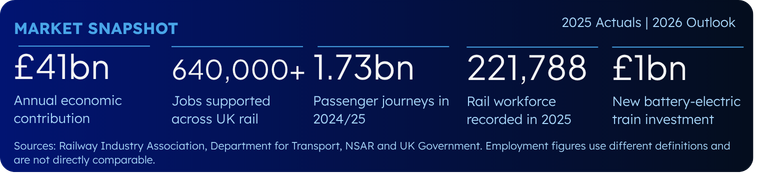
- Rolling Stock Investment: £1bn investment in 29 British-built battery-electric trains.
- Great British Railways: Ongoing reform to create a more integrated approach to rail operations and infrastructure.
These developments are supporting opportunities across civil engineering, signalling, electrification, rolling stock manufacturing and technical project delivery.
Infrastructure & Technology
Technology is playing an increasingly important role in improving network performance, reliability and operational efficiency.
Investment in digital signalling, electrification, predictive maintenance and advanced rolling stock is helping modernise the railway while supporting decarbonisation objectives.
The introduction of battery-electric trains and increasingly integrated infrastructure planning is also creating demand for specialist expertise across electrical systems, software, automation and advanced manufacturing.
Workforce & Talent Insight
The UK rail industry continues to face significant workforce challenges as major programmes progress and demand for specialist engineering and technical skills increases.
Demand remains strong across civil engineering, signalling, electrification, rolling stock, mechanical and electrical engineering, project management, maintenance and infrastructure delivery.
According to NSAR's 2025 Workforce Survey, the industry recorded 221,788 workers, with around one-third aged 50 or over. Up to 70,000 workers could leave through retirement and other forms of attrition by 2030.
With competition for specialist skills from energy, defence and infrastructure, employers are increasingly focused on apprenticeships, upskilling, succession planning and long-term workforce strategies.
Market Outlook & Talent Insight
The UK rail industry is entering a period of sustained modernisation, structural reform and infrastructure delivery.
Major investment programmes, rolling stock upgrades and the development of Great British Railways are expected to shape the sector's future, creating opportunities across engineering, manufacturing, technology and maintenance.
However, successful delivery will depend on balancing investment with productivity, supply chain capability and workforce availability.
For employers, attracting, developing and retaining specialist talent will be essential to delivering major programmes, improving network performance and supporting the UK's long-term rail ambitions.
Sources & Further Reading
- Railway Industry Association | UK Rail: Driving Growth and Jobs Across the Country
- Department for Transport | Rail Trends 2025
- NSAR | Findings from the 2025 Rail Workforce Survey
- UK Government | New British-Built Battery-Electric Trains
- Office of Rail and Road | Network Rail Capital Investments
- UK Government | HS2 Six-Monthly Report, May 2026
- UK Government | Great British Railways Rolling Stock Strategy


