


Aerospace 2026 Review & 2027 Predictions

Demand was never aerospace's problem in 2026. Order books are full, deliveries hit record monthly highs, and the UK's combat air programme moved from concept into detailed design.
The real constraint was capacity: parts, production lines and, above all, people. As 2027 approaches, the companies that win will be the ones that can hire, train and keep the engineers needed to turn a decade-long backlog into aircraft.
Here's our round-up of the year in aerospace, and what we expect 2027 to bring for the industry and its workforce.
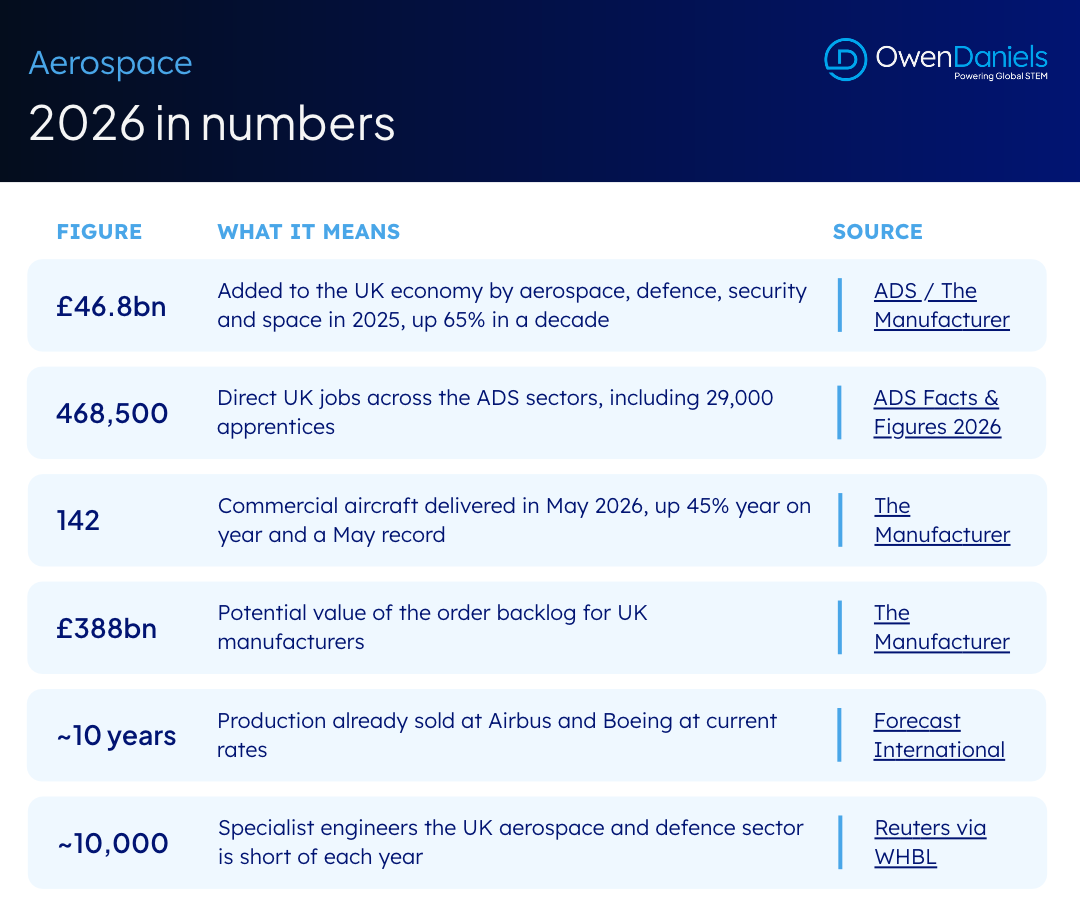
The moments that defined 2026
1. Record deliveries, but still not enough
Airbus and Boeing both lifted output this year. Boeing had its strongest first quarter in years, and Airbus retook the lead by the end of May (Migflug). Even so, Aviation Week forecasts around 1,686 commercial deliveries for 2026, still slightly below 2018 levels (Aviation Week). Demand is outrunning the supply chain's ability to build.
2. GCAP moves into detailed design
The UK's Defence Investment Plan committed £8.6bn to the Global Combat Air Programme over four years. In July, Edgewing, the BAE Systems, Leonardo and Japanese joint venture, was awarded a £4.6bn contract running to December 2027 (Calibre Defence). A further £708m went to BAE Systems for UK technology including software, digital engineering and infrastructure (BAE Systems).
3. Farnborough puts skills centre stage
The July airshow brought big orders, but the talent gap dominated the conversation. More than half of licensed UK aerospace engineers are over 50 and fewer than one in ten are under 30, according to the Royal Aeronautical Society (Reuters via WHBL). ADS launched its There's Aerospace For You campaign to tackle an estimated 10,000 unfilled technical roles (Bristol247).
4. Supply chain is still the bottleneck
Engine availability, castings and forgings continued to hold back output. Many programmes still rely on drawing down stored inventory rather than producing at a stable rate (Forecast International). Manufacturers are turning to additive manufacturing and digital tools to qualify replacement parts faster (Deloitte).
Five predictions for 2027
1. Another production step-up will stretch the supply chain further.
Boeing's next stable 737 MAX rate of 47 a month is now a 2027 goal, and Airbus is still refining its path to 70–75 A320neo-family aircraft a month with Pratt & Whitney (Aviation Week). Talent impact: Tier 1 and Tier 2 suppliers will compete hard for production engineers, quality inspectors and supplier development specialists.
2. GCAP becomes a major UK hiring engine.
The current development contract runs to the end of 2027, around when the UK demonstrator is expected to fly (Calibre Defence). Talent impact: Rising demand for systems engineers, software and avionics engineers, and model-based systems engineering (MBSE) skills, many requiring security clearance.
3. Aftermarket and MRO demand outpaces new build.
Aviation Week expects engine MRO to grow faster than the wider maintenance market, at about 4.1% a year (Aviation Week). Some forecasts identify 2027 as the worst year for maintenance technician shortages (Leeham News). Talent impact: Licensed aircraft engineers (B1/B2) and engine specialists will be among the hardest roles to fill.
4. Aerospace competes with tech for engineering talent.
Tech and AI employers often offer easier entry and higher pay for similar engineering skills (Reuters via WHBL). Talent impact: Employers will need sharper employer branding, faster hiring processes and clearer career paths to keep pace.
5. Digital and additive manufacturing go mainstream.
Digital twins, additive manufacturing and digital production tools are moving from pilots into everyday supply chain use (Deloitte). Talent impact: Demand for engineers who combine traditional aerospace knowledge with data and digital skills.
Roles to watch in 2027
Based on the trends above and regional skills research such as Hampshire Chamber of Commerce's defence and aerospace white paper (Portsmouth News), these are the roles we expect to be most in demand:
- Licensed aircraft engineers (B1/B2)
- Systems and MBSE engineers
- Software, avionics and embedded engineers
- Composites specialists
- CNC machinists and precision manufacturing technicians
- Quality and NDT inspectors
- Supplier quality and supply chain development engineers
- Security-cleared programme and project controls professionals
Aerospace roles pay around £52,600 on average, about a third above the UK average (Bristol247). For role-by-role pay, link here to the Owen Daniels UK STEM Salary Guide 2026.
The Owen Daniels view
2026 has seen huge growth within many areas of the aerospace supply chain and this is showing no signs of slowing down as we approach 2027. With further investment within both the aerospace and defence industries forecast, an increase in MRO activity being realised, and large arrears within several key supply chains, there is both enormous opportunity, but also risk. With skills shortages and an extremely competitive market for talent becoming ever-more apparent, the most successful manufacturers within the aerospace market in 2027 will likely be the ones who plan their recruitment and hiring strategy ahead of time, and who have a blended workforce incorporating both permanent employees and flexible contract labour.
- David May, Head of Division, Owen Daniels
Whether you're scaling a production line, building a GCAP-ready engineering team or struggling to fill licensed engineer roles, Owen Daniels connects aerospace employers with the specialist talent they need, on a permanent, contract or RPO basis.
FAQs
What were the biggest aerospace trends in 2026?
Record monthly aircraft deliveries, order backlogs of around a decade, persistent supply chain constraints and a growing engineering skills shortage. In the UK, GCAP moved into detailed design with a £4.6bn contract.
What are the aerospace industry predictions for 2027?
Further production rate increases at Airbus and Boeing, faster growth in MRO and engine maintenance, more hiring linked to GCAP, and wider use of digital and additive manufacturing.
Is there a skills shortage in UK aerospace?
Yes. The UK aerospace and defence sector is short of around 10,000 specialist engineers a year, and over half of licensed aerospace engineers are over 50.
Which aerospace jobs will be most in demand in 2027?
Licensed aircraft engineers, systems and MBSE engineers, software and avionics engineers, composites specialists, CNC machinists, and quality and NDT inspectors.
Sources
- ADS Industry Facts & Figures 2026
- The Manufacturer: UK aerospace, defence and space contribute £46.8bn
- The Manufacturer: Aircraft deliveries hit record high
- Aviation Week: 2026 airliner deliveries to be short of 2018
- Forecast International: June 2026 orders and deliveries
- Forecast International: July 2026 orders and deliveries
- Migflug: Boeing v Airbus 2026 delivery race
- Calibre Defence: GCAP funding and £4.6bn contract
- BAE Systems: £708m GCAP investment
- Reuters via WHBL: Aerospace fights for young recruits
- Bristol247: There's Aerospace For You campaign
- Leeham News: Workforce shortfalls
- Deloitte: Midyear aerospace and defence outlook
- Portsmouth News: Hampshire defence and aerospace skills
Up next


