


Automotive 2026 Review & 2027 Predictions

For UK automotive, 2026 was a year of two speeds. Electric car sales hit new records and the UK passed two million battery-electric registrations. Production, though, stayed flat as manufacturers juggled model changeovers, high energy costs and trade uncertainty.
The pressure point for 2027 is clear. The ZEV mandate rises again, new EV models and battery plants need to ramp up, and the industry needs engineers and technicians who can build and service electric vehicles at scale.
Here's our round-up of the year in automotive, and what we expect 2027 to bring for the industry and its workforce.
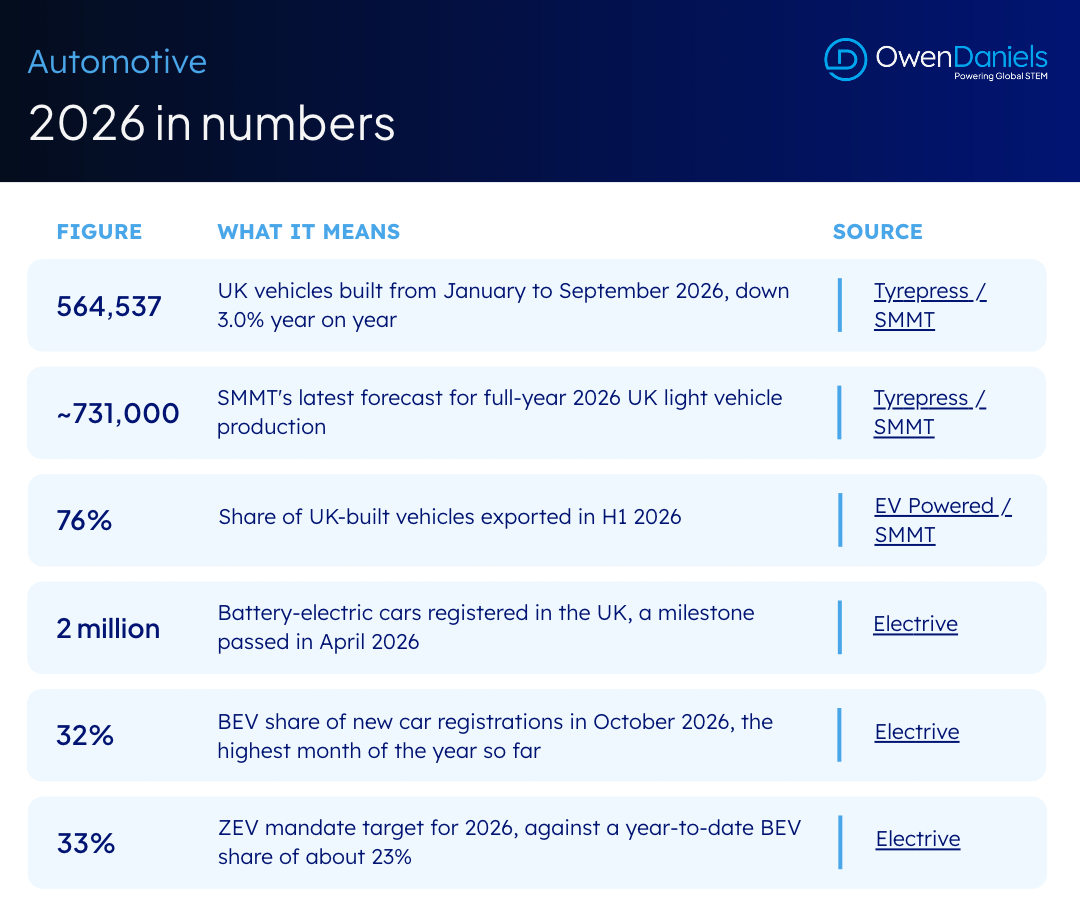
The moments that defined 2026
1. EV demand grew, but not fast enough for the mandate
Battery-electric registrations rose strongly through spring, with April up 59% year on year (Electrive). Even so, the market remained around ten points behind the 33% ZEV mandate target in Q1 (Automotive Manufacturing Solutions). SMMT repeatedly called for an urgent review of the transition.
2. Production stalled despite a strong export quarter
UK output fell 7.5% in the first half, though Q2 was almost flat and car exports rose for three months in a row by June. Electrified models still made up around four in ten cars built (EV Powered / SMMT). SMMT cut its full-year forecast from around 790,000 to around 740,000 units (AM Online).
3. Energy costs and trade rules became the investment test
SMMT warned that uncompetitive industrial electricity prices, the cost of meeting the ZEV mandate and EU Rules of Origin pressures are weakening the case for building cars in the UK (EV Powered / SMMT). These three factors will shape where the next round of model investment lands.
4. The battery supply chain took shape, more slowly than planned
Agratas's £4bn Somerset gigafactory, which will supply Jaguar Land Rover among others, is targeting up to 40GWh a year and around 4,000 jobs at full scale. Its first building's opening has slipped to 2027 (Battery Tech).
Five predictions for 2027
1. The ZEV mandate review becomes the year's biggest story.
The mandate's mid-point review is due in early 2027 (Automotive Manufacturing Solutions). SMMT forecasts a 32% BEV share in 2027, still short of the target (Electrive). Talent impact: Manufacturers will need regulatory, homologation and product planning specialists who can respond quickly to policy change.
2. Production returns to growth, led by new EV models.
SMMT's latest outlook forecasts UK output recovering to 752,000 vehicles in 2027 as new models, mostly electric, enter production (AM Online). Reaching one million vehicles would still need around 40% growth and new model investment (EV Powered / SMMT). Talent impact: Launch and ramp-up roles will be in demand, including manufacturing engineers, launch managers and quality engineers.
3. Battery manufacturing becomes a major UK employer.
With Agratas due to open its first building in 2027 (Battery Tech), battery skills will move from niche to mainstream. Talent impact: Strong demand for battery cell engineers, electrochemists, process engineers and maintenance technicians with high-voltage experience.
4. Software and electronics roles outgrow mechanical ones.
As EVs and connected vehicles become the norm, more engineering effort shifts to software, electronics and power electronics. Talent impact: Automotive will compete with tech firms for embedded software, controls and functional safety engineers.
5. The EV technician gap starts to bite.
The IMI has projected that the UK will need around 90,000 EV-qualified technicians by 2030 (IMI). With two million BEVs now on the road and more coming out of warranty, demand for aftersales skills will rise. Talent impact: Dealer groups, fleets and service networks will compete hard for high-voltage-qualified technicians.
Roles to watch in 2027
- Battery cell and battery systems engineers
- High-voltage and power electronics engineers
- Embedded software and controls engineers
- Functional safety and cybersecurity engineers
- Manufacturing and launch engineers
- Quality and supplier quality engineers
- Homologation and regulatory compliance specialists
- EV-qualified service technicians
The Owen Daniels view
The UK automotive industry has spent the last couple of years navigating significant uncertainty, with the transition to electric vehicles, changing consumer demand and wider economic pressures making it difficult for manufacturers to find any real consistency. However, I believe 2027 could represent a turning point. New model launches, investment in battery manufacturing and the continued shift towards electrification should create renewed opportunities across the sector, although the real winners will be those businesses that get ahead of the curve and secure the specialist engineering and technical talent they need.
The challenge will be having the right people in place to deliver that growth, particularly across battery engineering, software, controls and advanced manufacturing. It is also important not to forget the traditional engineering expertise that remains fundamental to the industry. Those who invest in talent early will put themselves in a much stronger position through 2027.
- Ben Staines, Head of Division, Owen Daniels
Whether you're launching a new EV programme, building a battery engineering team or scaling up production, Owen Daniels connects automotive employers with the specialist talent they need, on a permanent, contract or RPO basis.
FAQs
What happened in the UK automotive industry in 2026?
UK vehicle production was broadly flat at around 740,000 units, while battery-electric car sales hit records and the UK passed two million BEV registrations. The market still fell short of the 33% ZEV mandate target.
What are the automotive industry predictions for 2027?
A review of the ZEV mandate, a return to production growth (to around 752,000 vehicles) led by new EV models, the opening of the Agratas gigafactory, and rising demand for software, battery and EV service skills.
What is the ZEV mandate?
The Zero Emission Vehicle mandate requires a rising share of each manufacturer's new UK car sales to be zero emission. The target is 33% in 2026, and a mid-point review is due in early 2027.
Which automotive jobs will be most in demand in 2027?
Battery engineers, high-voltage and power electronics engineers, embedded software engineers, manufacturing and launch engineers, and EV-qualified technicians.
Sources
- EV Powered: UK vehicle production falls in first half of 2026
- AM Online: UK car manufacturing sees best September for three years
- AM Online: UK output to rebound in 2026, forecasts SMMT
- Electrive: UK passes two million EVs as market share hits 26%
- Automotive Manufacturing Solutions: ZEV mandate gap widens
- Battery Tech: Agratas plans for UK's largest EV battery plant
- IMI: 2026 marks crossroads for EV skills gap
Up next


