


The Owen Daniels Energy & Power Market Update | UK Energy & Nuclear Insight

The UK energy and power sector is entering a significant period of investment and transformation, driven by the transition to low-carbon generation, rising electricity demand and renewed focus on energy security.
Renewables accounted for a record 52.5% of UK electricity generation in 2025, while nuclear is moving back to the centre of the UK's long-term energy strategy. Major programmes including Hinkley Point C, Sizewell C and Small Modular Reactors are creating a new pipeline of investment across engineering, manufacturing and infrastructure.
As these programmes move forward, the challenge is increasingly shifting from ambition to delivery. Access to infrastructure, specialist skills and supply chain capability will be critical to delivering the UK's future energy system.
Market Snapshot (2025 Actuals | 2026 Outlook)
Key Industry Stats
Sector Growth & Generation
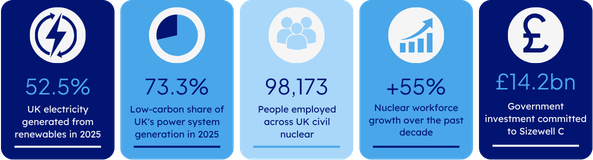
- Renewables generated a record 52.5% of UK electricity in 2025
- Wind accounted for 30% of total UK electricity generation
- 73.3% of Great Britain's power system generation came from low-carbon technologies in 2025
- UK civil nuclear employment reached a record 98,173 people
- Major investment continues across new nuclear, grid infrastructure and clean power
Programme & Market Activity
Nuclear is entering a major period of renewal, with investment shifting from maintaining the existing fleet towards delivering the UK's next generation of nuclear capacity.
Hinkley Point C remains one of the UK's largest infrastructure projects, while Sizewell C is moving into delivery following significant government investment. Alongside large-scale nuclear, the UK's Small Modular Reactor programme represents a new route to future capacity, with more than £2.5 billion committed to the programme and Rolls-Royce SMR selected to support its delivery.
Together, Hinkley Point C, Sizewell C and the initial SMR programme are expected to add almost 8GW of nuclear capacity during the 2030s, enough to power the equivalent of around 15 million of today's homes. Beyond generation, these programmes are creating long-term opportunities across engineering, construction, manufacturing, commissioning and the wider UK supply chain.
Energy Infrastructure & Technology
The growth of nuclear and renewable generation is changing the infrastructure and technology required to support the UK's power system.
Investment in transmission networks, substations, grid reinforcement, storage and smart energy systems will be increasingly important as electricity demand grows and the generation mix becomes more complex. Nuclear's ability to provide firm low-carbon power will sit alongside increasing renewable capacity, storage and other flexible technologies.
Technology is also reshaping nuclear and power delivery. Small Modular Reactors, digital twins, AI, automation, advanced manufacturing and predictive maintenance are creating opportunities to improve design, construction and asset performance. Advanced nuclear technologies could also support applications beyond electricity generation, including industrial heat and hydrogen production.
The result is an increasingly integrated and technology-led sector, requiring traditional engineering expertise alongside growing digital and advanced technology capability.
Workforce & Talent Insight
The nuclear workforce is already responding to this investment. UK civil nuclear employment reached a record 98,173 people in 2025, increasing by around 11,000 in one year and 55% over the past decade.
Demand is growing across EC&I, electrical and mechanical engineering, commissioning, project controls, nuclear safety, quality, systems engineering, manufacturing and skilled trades. Hinkley Point C, Sizewell C, SMRs and wider grid investment will continue to create requirements across permanent workforces and specialist project capability.
However, many of these skills are simultaneously required across defence, infrastructure, renewables and advanced manufacturing. As major programmes overlap, competition for experienced professionals is likely to intensify.
For employers, workforce planning is becoming a programme delivery issue. Building talent pipelines, developing existing skills and planning requirements earlier will be increasingly important as nuclear and wider power projects move through their different delivery phases.
Market Outlook & Talent Insight
The UK Energy & Power sector is moving from ambition into delivery.
Record renewable generation, major nuclear investment and growing infrastructure requirements are creating long-term opportunities across engineering, manufacturing and technology. Nuclear will play an important role in that transition, with Hinkley Point C, Sizewell C and the UK's SMR programme creating a significant pipeline of activity into the 2030s.
For businesses across the sector, this creates opportunity but also increasing competition for capability. Organisations that align workforce planning with future programmes, invest in skills and strengthen access to specialist talent will be best positioned for the next phase of UK energy investment.
The UK's nuclear ambition is moving into delivery, and having the skills and capability to deliver it will be critical.
Sources & Further Reading
Market data, investment figures and workforce insights referenced within this update have been informed by the latest available UK Government and industry publications:
- Department for Energy Security & Net Zero – Energy Trends: March 2026 – UK electricity generation data for 2025, including 52.5% renewable generation, 30% wind generation and wider energy mix trends.
View Energy Trends: March 2026 - UK Government – Advanced Nuclear Framework 2026 – supports the £14.2bn Sizewell C commitment, £2.5bn+ SMR programme and almost 8GW of new nuclear capacity expected from Hinkley Point C, Sizewell C and the initial SMR programme during the 2030s.
View the Advanced Nuclear Framework - Nuclear Industry Association – UK Nuclear Jobs Map 2025 – workforce data including 98,173 people employed across UK nuclear, an increase of 11,000 in one year and 55% growth over the past decade.
View the UK Nuclear Jobs data - UK Government – Sizewell C Investment Announcement – supports the £14.2bn Sizewell C investment, alongside plans to create 10,000 jobs and 1,500 apprenticeships through the programme.
View the Sizewell C announcement - Great British Energy – Nuclear / UK Government SMR Programme – supports the estimate of approximately 3,000 jobs at peak construction, with thousands more expected across the UK supply chain.
Statistics are based on the latest available published data at the time of writing.


