


Owen Daniels Marine & Naval Industry Update: UK Insight | 2026 OUTLOOK

The UK marine and naval sector is entering a new phase of growth, driven by defence investment, offshore infrastructure development, maritime modernisation, and increasing demand for sovereign engineering capability.
The industry remains strategically critical to the UK economy and national security, supporting highly skilled employment across shipbuilding, advanced manufacturing, defence, and maritime operations.
However, as investment accelerates across naval programmes, offshore capability, and next-generation vessel technology, the sector’s challenge is shifting.
The defining constraint is no longer demand, but the industry’s ability to deliver increasingly complex programmes amid growing pressure on supply chains, infrastructure, and access to skilled talent.
UK Market Snapshot (2025 Actuals | 2026 Outlook)
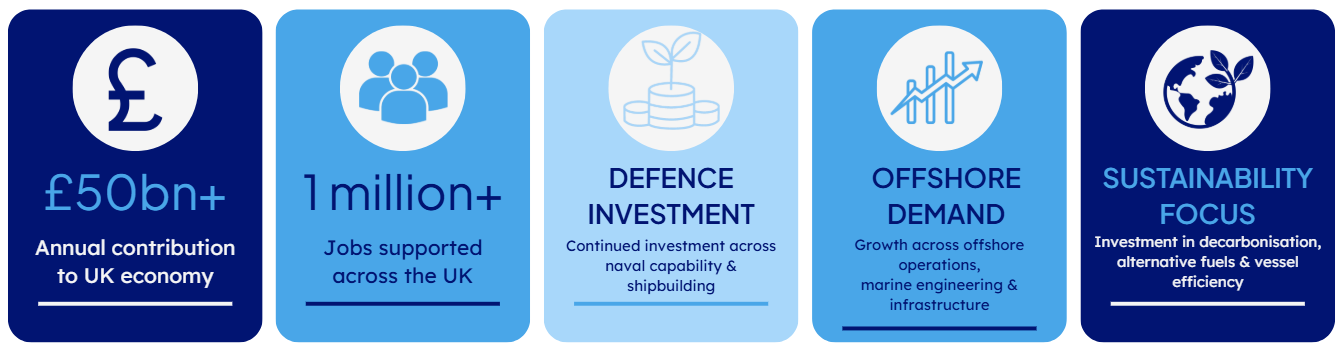
Key Industry Stats
Infrastructure, Investment & Modernisation
Investment across the marine and naval sector remains strong, supported by defence spending, naval fleet modernisation, offshore infrastructure development, and long-term maritime capability programmes.
Organisations are increasing investment across advanced manufacturing, vessel technology, systems integration, automation, and digital engineering to improve operational capability and long-term resilience.
At the same time, increasing pressure on programme delivery, supply chain security, and infrastructure capability is reshaping how major projects are planned and executed.
Decarbonisation also remains a major industry priority, with continued focus on alternative fuels, emissions reduction, energy efficiency, and sustainable vessel design.
Industry Transformation & Delivery Challenges
The sector is undergoing significant transformation across both commercial and defence-led programmes.
Shipbuilding, naval infrastructure, offshore operations, and maritime engineering are evolving rapidly through digital technology, automation, and increasingly advanced systems capability.
At the same time, organisations are facing growing pressure around:
- Programme delivery and project complexity
- Supply chain resilience and infrastructure capability
- Workforce shortages across specialist engineering functions
- Sustainability and regulatory requirements
- Long-term technical capability and succession planning
The challenge is no longer simply securing investment, but ensuring the capability exists to deliver programmes safely, efficiently, and at scale. This is increasing demand for specialist expertise across naval architecture, marine engineering, systems integration, advanced manufacturing, project delivery, and offshore operations.
Workforce & Talent Insight
The marine and naval sector continues to experience sustained demand for skilled technical professionals.
Competition for experienced engineers, manufacturing specialists, project managers, and defence-cleared talent remains high, particularly where skills overlap with adjacent sectors including aerospace, energy, rail, and advanced engineering.
A significant proportion of the sector’s workforce is also approaching retirement age, increasing pressure on technical succession planning and long-term capability development.
At the same time, the workforce is evolving rapidly, with increasing demand for digital capability, systems integration expertise, automation, and technology-led engineering skills alongside traditional maritime experience.
Demand continues to grow across:
- Marine engineering
- Naval architecture
- Systems engineering
- Manufacturing & production
- Project & programme management
- Offshore operations
- Defence & security-cleared roles
As infrastructure and defence investment increases, organisations are placing greater emphasis on workforce planning, retention, and long-term capability development.
The challenge is no longer simply hiring at volume, but ensuring businesses can build sustainable technical capability to support future programme delivery.
Market Outlook & Talent Insight
The outlook for the UK marine and naval sector remains strong, supported by sustained defence investment, offshore development, and long-term infrastructure modernisation.
However, as programmes become larger, more complex, and increasingly technology-driven, the defining challenge is shifting from investment to delivery capability.
Access to skilled talent, resilient supply chains, and long-term engineering capability will increasingly determine which organisations are best positioned to deliver future growth.
Businesses that invest in workforce strategy, technical expertise, and scalable delivery capability will be better placed to support the next phase of maritime transformation.
The future of the sector will be defined not just by investment, but by the ability to deliver strategic capability through skilled people, resilient infrastructure, and advanced engineering expertise.
Up next


