


The Owen Daniels Automotive Market Update: UK & Midlands Insight | 2026 Outlook

As we move through 2026, the UK automotive industry is firmly in transition, not decline. The sector continues to balance strong consumer demand with structural changes in manufacturing, electrification, and workforce capability.
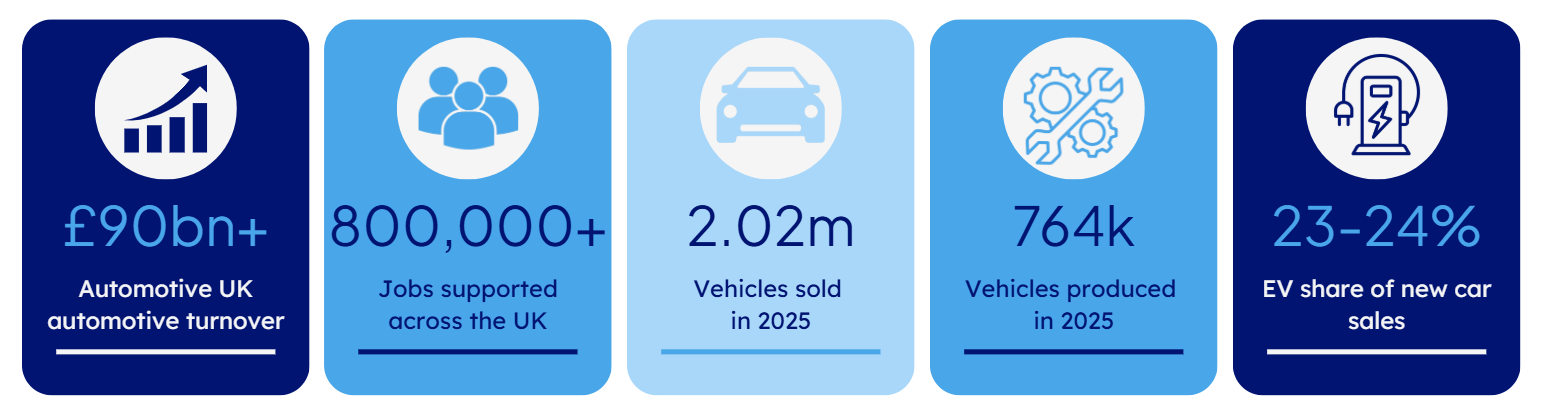
The industry remains a cornerstone of the UK economy, generating over £90 billion in turnover and contributing more than £20 billion in value added. It supports over 800,000 roles across the wider ecosystem, reinforcing its national importance.
However, the shape of the industry is evolving rapidly. Electrification, global competition, trade policy, and skills transformation are now the defining forces shaping future growth.
Market Snapshot (2025 Actuals | 2026 Outlook)
Consumer demand continues to strengthen, while manufacturing adjusts to transformation.
Key Industry Stats
UK Market Demand
- 2.02 million new car registrations in 2025
- Forecast 2.05 million vehicles in 2026
- EV market share at approximately 23 to 24% in 2025
- Expected to reach around 28% in 2026
UK Manufacturing Output
- Approximately 764,000 vehicles produced in 2025
- Forecast recovery to 790,000 to 820,000 units in 2026
- Around 75% of production exported globally
The Midlands Perspective
The Midlands remains the centre of UK automotive manufacturing and innovation.
The region employs approximately 50,000 people in automotive roles, representing over 30% of the UK automotive workforce. It produces around one third of all UK vehicles and generates an estimated £13 to £14 billion in automotive exports annually.
Looking ahead, the Midlands is central to future growth: £850m to £950m
Potential additional output in EV and battery manufacturing
11,000 to 12,000 jobs future employment opportunity linked to electrification
This positions the Midlands not just as a legacy manufacturing base, but as a critical driver of the UK’s transition to electric and advanced vehicle production.
Industry Transformation
The direction of travel is clear and accelerating.
Electrification continues to reshape the market, with government targets requiring 28% zero emission vehicle sales in 2025, rising significantly by 2030. While adoption is increasing, a gap remains between policy ambition and consumer demand.
The UK Government has committed £2.5 billion through the DRIVE35 programme to support EV manufacturing, battery technology, and supply chain development through to 2035.
At the same time, new trade agreements are reducing export barriers and improving global competitiveness. Manufacturing is becoming more advanced, with increasing adoption of AI, robotics, and smart factory technologies, alongside a shift towards higher value, technology-led production.
Workforce & Employment Insight
The most significant transformation is taking place within the workforce.
There are currently around 17,000 vacancies across the UK automotive sector. While vacancy rates have stabilised, the demand for specialist skills continues to rise, particularly in electrification, software, automation, and data-driven manufacturing.
Apprenticeships and training programmes are increasing, with over 30% growth in uptake in recent years. However, the challenge is not simply hiring more people, but developing the right capabilities.
It is estimated that 61% of automotive roles will require new skills by 2035. This includes expertise in high-voltage systems, battery technology, software integration, and AI-led production environments.
The industry is shifting from a traditional mechanical workforce to one that is increasingly digital, electrified, and highly specialised.
Market Outlook & Talent Insight
The UK automotive sector is not contracting, it is redefining itself.
Demand remains strong and investment continues. However, production is being reshaped by electrification, global competition and supply chain change. The defining constraint is no longer demand, but access to the right skills.
Production is expected to recover steadily, with the potential to exceed one million units by 2027 to 2028, supported by continued investment and new model launches. EV adoption will continue to accelerate, alongside a growing shift towards high skill, high value roles across electrification, software and advanced manufacturing.
For businesses, the opportunity is clear. Those that align workforce strategy with industry change, invest in skills, and take a proactive approach to talent will be best positioned to lead the next phase of growth.


