


The Owen Daniels Defence & Aerospace Market Update

The UK defence and aerospace sector continues to experience sustained growth, underpinned by increased defence spending, commercial aerospace recovery and investment in next-generation technologies.
Government commitments to strengthen national security, coupled with expanding global aerospace programmes, are creating long-term opportunities across engineering, manufacturing and advanced technology. However, the pace of growth is placing increasing pressure on supply chains and access to highly skilled talent.
With innovation accelerating across autonomous systems, AI, cyber security, space, advanced manufacturing and propulsion, organisations are competing for specialist capability in an increasingly constrained labour market.
Market Snapshot (2025 Actuals | 2026 Outlook)
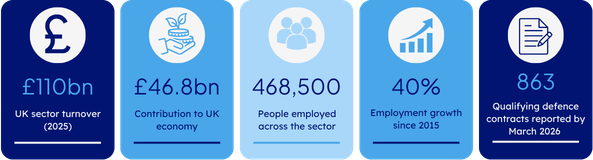
Key Industry Stats
Source: ADS Group, Industry Facts & Figures 2026
Sector Growth & Investment
- UK aerospace, defence, security and space sectors generated nearly £110 billion turnover in 2025
- Contributed £46.8 billion in GVA to the UK economy
- 468,500 people employed across the sectors
- Employment has increased by almost 40% since 2015
Programme & Market Activity
The sector continues to benefit from significant investment across defence capability and commercial aerospace, including:
- Global Combat Air Programme (GCAP)
- AUKUS submarine programme
- Dreadnought submarine programme
- Increased investment in autonomous systems, AI and advanced air mobility
- Strong commercial aircraft demand supporting manufacturing and supply chains
Active Programmes & Technology
The defence and aerospace sector continues to benefit from significant investment across national defence, commercial aerospace, and next-generation technologies.
Major programmes including GCAP, AUKUS, the Dreadnought programme, and continued investment in space capability are driving long-term demand across engineering, manufacturing, and programme delivery. At the same time, increasing commercial aircraft orders are supporting production and strengthening supply chains.
Technology is advancing at pace, with organisations accelerating investment in AI, autonomous systems, digital engineering, cyber resilience, advanced manufacturing, and digital twins. These technologies are improving design, production, predictive maintenance, and operational capability, while reshaping the skills required across the sector.
As programmes become more complex and technology-led, organisations are increasingly seeking engineers and technical specialists with expertise across software, systems integration, automation, data, and advanced manufacturing to support future capability.
Workforce & Talent Insight
The defence and aerospace sector continues to see strong demand for highly skilled engineering and technical professionals. As investment grows across defence capability, aerospace innovation, and next-generation technologies, organisations are competing for increasingly specialist talent.
Demand remains highest across systems, software, electronics, avionics, mechanical design, manufacturing, cyber security, AI, project management, and security-cleared roles. Recruitment activity is also increasing across quality, supply chain, maintenance, and programme delivery functions.
With an ageing workforce, security clearance requirements, and growing competition from adjacent sectors, attracting and retaining experienced professionals remains a key challenge. In response, organisations are investing in apprenticeships, upskilling, and long-term workforce planning to build capability and support future programme delivery.
Market Outlook & Talent Insight
The UK defence and aerospace sector is entering a sustained period of investment, innovation, and programme delivery.
Continued government spending, international partnerships, and commercial aerospace growth are creating long-term opportunities across engineering, manufacturing, and technology. As programmes become more complex, demand for specialist talent will continue to grow across design, production, digital engineering, and support functions.
For employers, workforce planning is becoming as critical as programme delivery. Organisations that invest in attracting, developing, and retaining skilled professionals will be best positioned to deliver programmes, strengthen resilience, and drive long-term growth.
Sources & Further Reading
Market data and industry insights referenced within this update have been informed by the latest available industry and government publications, including:
- ADS Group, Industry Facts & Figures 2026 – sector turnover, GVA, employment, exports and workforce data.
- UK Government / Ministry of Defence – defence investment, policy and major programme information.
- UK Government – Defence Industrial Strategy 2025 — use for government defence policy, investment priorities, procurement, innovation and UK industrial capability.
- BAE Systems 2026 Half-Year Results – current programme and order book context.
- Single Source Regulations Office (SSRO) – UK qualifying defence contract data.


