


Recruitment Supplier Consolidation: What Should You Measure?

Reducing the number of recruitment suppliers can help simplify procurement, improve cost control and create greater consistency. But for STEM businesses, successful supplier consolidation is about more than having fewer agencies on your preferred supplier list.
With specialist skills in demand across engineering, manufacturing, aerospace, automotive, rail and energy, it's essential that your recruitment supply chain continues to deliver the expertise and talent your business needs.
So, how do you measure whether consolidating your recruitment suppliers is actually working?
Why consolidate your recruitment suppliers?
Managing multiple recruitment agencies can lead to duplicated candidate submissions, inconsistent fees, varying service levels and increased administration.
A more streamlined supply chain can help you:
- Improve visibility of recruitment spend.
- Reduce supplier administration and duplication.
- Establish consistent commercial terms.
- Improve supplier accountability and performance.
- Strengthen recruitment reporting and governance.
However, reducing supplier numbers must not come at the expense of specialist expertise or access to talent.
Six measures of successful supplier consolidation
1. Recruitment quality
Are your remaining suppliers delivering suitable candidates with the right skills and experience?
Measure:
- Candidate shortlist and interview rates.
- Interview-to-offer ratios.
- Offer acceptance rates.
- Hiring manager feedback.
- Retention or contractor assignment completion, where available.
STEM consideration: Assess performance by discipline. A supplier may be strong in mechanical engineering but have limited access to automation, electronics or specialist manufacturing talent.
2. Time to hire
Has consolidation improved the speed and responsiveness of your recruitment process?
Measure:
- Time from vacancy approval to shortlist.
- Time to fill.
- Supplier response times.
- Time taken to fill hard-to-fill roles.
- Ability to respond to changing project requirements.
For businesses working to production schedules or project deadlines, delays in securing technical talent can have a wider operational impact.
3. Total recruitment cost
Lower agency fees do not automatically mean lower recruitment costs. Consider the wider expense of managing suppliers and leaving vacancies unfilled.
Measure:
- Average agency fees and contractor margins.
- Total external recruitment spend.
- Cost per hire by vacancy type.
- Internal time spent managing suppliers.
- Costs associated with prolonged vacancies.
Compare like-for-like roles, recognising that specialist engineering appointments may have different costs from higher-volume recruitment./p>
4. Supplier performance
A smaller supplier panel should make performance easier to monitor and manage.
Measure:
- Supplier fulfilment rates.
- Candidate submission quality.
- Compliance with agreed service levels.
- Reporting accuracy and consistency.
- Responsiveness to feedback.
Use a consistent supplier scorecard and regular performance reviews to identify which suppliers are genuinely adding value.
5. Specialist talent coverage
Consolidation should not reduce your access to the technical skills your business relies on.
Measure:
- Coverage across key STEM disciplines.
- Access to niche and hard-to-find skills.
- Geographic and international reach, where relevant.
- Permanent and contract recruitment capability.
- Experience within your industry and project environment.
The objective is to retain the right expertise, not simply the largest or most established suppliers.
6. Candidate and hiring manager experience
Your recruitment suppliers represent your organisation throughout the hiring process. A more coordinated supply chain should create a consistent experience.
Measure:
- Hiring manager satisfaction.
- Candidate feedback.
- Interview scheduling and feedback times.
- Candidate withdrawal rates.
- Offer acceptance rates.
- Consistency of employer brand messaging.
A positive candidate experience can influence how people view your organisation, even when they are unsuccessful.
Creating a recruitment supplier scorecard
A supplier scorecard helps procurement and HR teams assess performance consistently and make decisions based on evidence.
The following weightings provide a useful starting point:
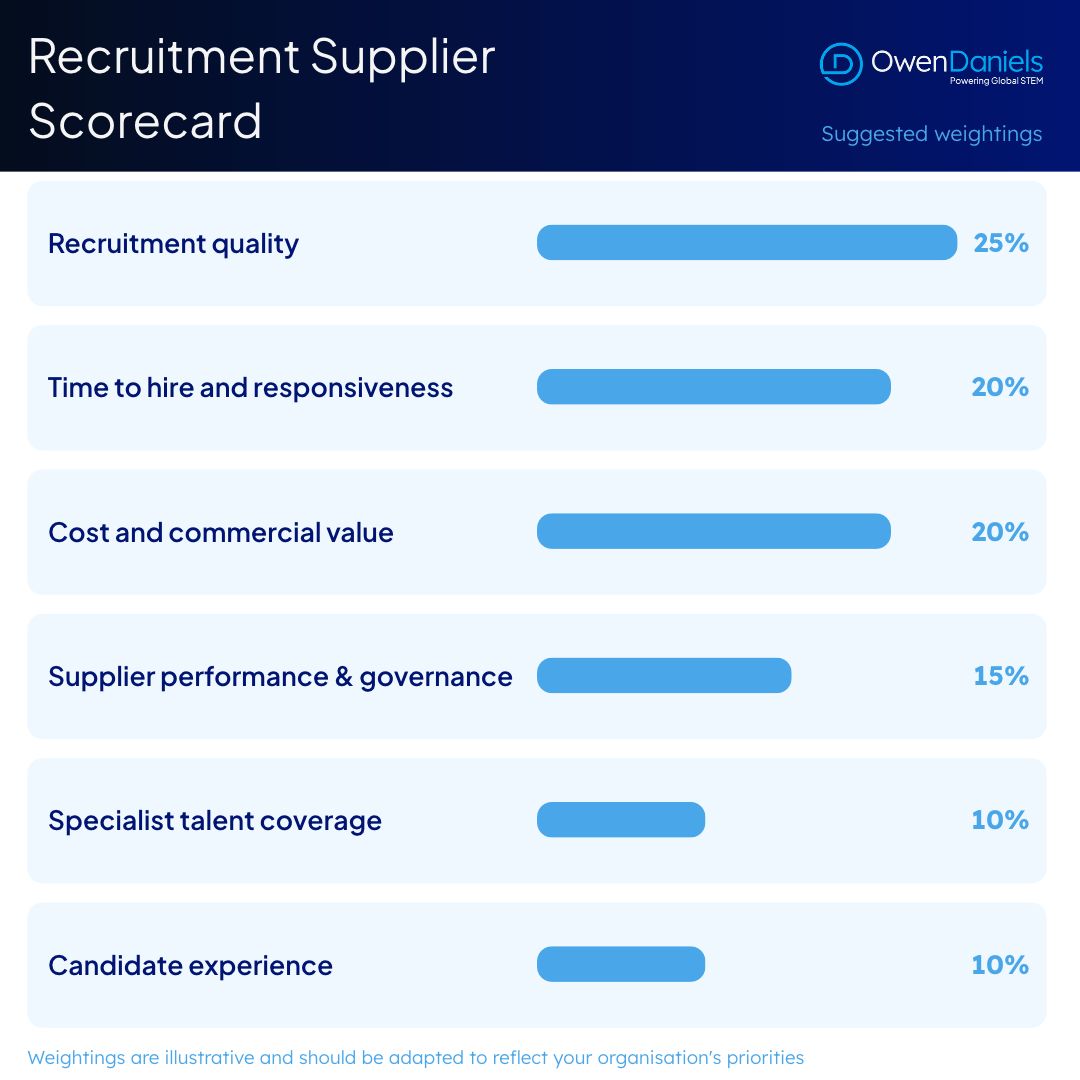
Review performance regularly and compare suppliers against similar vacancy types. A specialist aerospace engineering recruiter, for example, should be assessed in the context of the roles they support.
Common mistakes to avoid
When consolidating suppliers, avoid focusing solely on reducing costs or supplier numbers.
- Choosing on fees alone: Lower fees may come at the expense of candidate quality or specialist expertise.
- Removing specialist capability: Suppliers supporting niche or hard-to-fill vacancies may still be strategically important.
- Using inconsistent measures: Without agreed reporting, supplier comparisons can be misleading.
- Excluding hiring managers: Their feedback is essential when assessing candidate quality and service.
- Failing to review performance: Your supply chain should evolve as hiring demand and business priorities change.
Could RPO offer a more coordinated approach?
For some STEM organisations, the answer may not simply be to reduce the number of recruitment agencies, but to reconsider how recruitment is managed altogether.
Recruitment Process Outsourcing (RPO) offers a more integrated approach, bringing some or all of the recruitment process under a coordinated model.
This can help businesses improve visibility, establish consistent processes and reduce the time spent managing multiple suppliers independently.
It can be particularly valuable where organisations are experiencing inconsistent agency performance, increasing recruitment administration, limited cost visibility or changing hiring demand.
How Owen Daniels can help
At Owen Daniels, we understand that STEM recruitment is rarely one-size-fits-all. Different organisations face different challenges, from securing niche engineering skills to managing high-volume recruitment across multiple sites or projects.
Our RPO solutions are designed around your requirements. We can support specific parts of your recruitment process or work as an extension of your team, helping to manage the wider recruitment function.
By taking a tailored approach, we aim to help organisations improve recruitment visibility, strengthen delivery and create a supply chain that provides the right expertise and value.
Whether you are looking to improve your existing supplier model or explore a more integrated approach, we can help you assess what works best for your business.
Want to understand how your recruitment supply chain could work harder for your organisation?
Explore Owen Daniels' RPO solutions or speak to our team about your recruitment requirements.
FAQs
What is recruitment supplier consolidation?
Recruitment supplier consolidation is the process of reducing the number of agencies on your preferred supplier list (PSL) to improve cost control, reduce administration and create greater consistency across your recruitment process.
What are the risks of consolidating recruitment suppliers in STEM businesses?
The main risk is losing access to specialist expertise. In STEM sectors — engineering, manufacturing, aerospace, automotive and energy — some suppliers support niche or hard-to-fill roles that larger or more generalist agencies cannot cover. Consolidation should retain the right expertise, not simply reduce headcount.
How do you measure whether recruitment supplier consolidation is working?
Measure performance across six areas: candidate quality (shortlist and interview rates, offer acceptance), time to hire, total recruitment cost including cost per hire, supplier fulfilment and compliance, specialist talent coverage across STEM disciplines, and candidate and hiring manager satisfaction.
What should a recruitment supplier scorecard include?
A supplier scorecard should cover recruitment quality, time to hire and responsiveness, cost and commercial value, supplier performance and governance, specialist talent coverage, and candidate experience. Weightings should reflect your organisation’s priorities and be reviewed regularly.
What is the difference between PSL consolidation and RPO?
PSL consolidation reduces the number of external agencies you manage independently. RPO (Recruitment Process Outsourcing) goes further — bringing some or all of the recruitment process under a single coordinated model, which can improve visibility, reduce administration and create more consistent delivery across the business.
When should a STEM business consider RPO instead of supplier consolidation?
RPO tends to make most sense where businesses are experiencing inconsistent agency performance, increasing recruitment administration, limited cost visibility or significant changes in hiring demand. Rather than managing a reduced supplier panel, RPO provides an integrated recruitment function that scales with the business.


