


Owen Daniels Renewable Energy Market Update | 2025 ACTUALS | 2026 OUTLOOK

The UK renewable energy sector is accelerating, driven by net zero commitments, energy security, and sustained public and private investment.
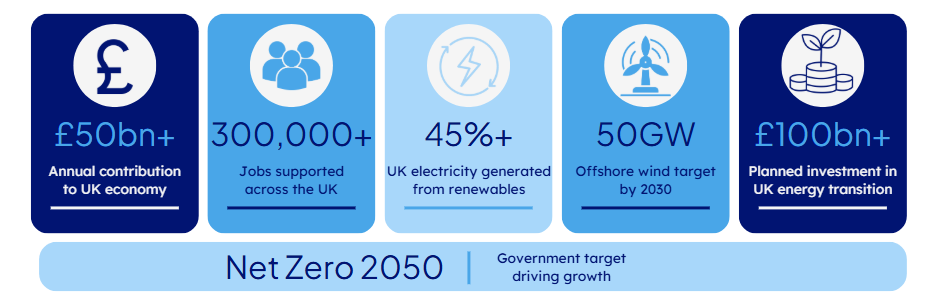
Now a core pillar of the UK economy, the sector contributes over £50 billion annually and supports hundreds of thousands of roles across generation, infrastructure, and supply chains.
As the market scales, the challenge is shifting. Growth is no longer defined solely by investment or demand, but by the ability to deliver projects at pace - placing increasing pressure on infrastructure and access to skilled talent.
UK Market Snapshot (2025 Actuals | 2026 Outlook)
Key Industry Stats
Energy Generation & Demand
- Renewables generated over 45% of UK electricity in 2025
- Offshore wind remains the largest contributor
- Electricity demand rising due to electrification across transport and industry
Capacity & Investment
- Offshore wind target of 50GW by 2030
- Continued expansion across solar, wind, and storage
- £100 billion+ planned investment across generation, grid, and infrastructure
Energy Infrastructure & Grid Capacity
The next phase of renewable growth will be defined not by generation, but by infrastructure.
While capacity continues to expand, the UK’s grid network is under increasing pressure. Delays in grid connections, planning approvals, and storage deployment are now key constraints on delivery.
- Grid connection queues stretching 5 to 10 years in some regions
- Significant investment required in transmission and distribution networks
- Battery storage and smart grid technology critical to balancing supply and demand
This marks a fundamental shift in the sector. The challenge is no longer building renewable capacity, but enabling it to connect, operate, and scale effectively.
As a result, demand is increasing for specialist expertise across grid engineering, infrastructure delivery, and energy systems integration.
Industry Transformation
The direction of travel is clear, and the pace of change is accelerating.
The UK is transitioning from a fossil fuel-based system to a renewable-led energy mix, with rapid expansion across offshore wind, solar, and storage. At the same time, emerging technologies such as hydrogen and alternative fuels are gaining momentum.
This evolution is increasing the complexity of the sector. Projects are becoming larger, more technically demanding, and more reliant on integrated systems and digital technologies./p>
Government policy and private investment continue to support long-term growth, however infrastructure constraints and delivery timelines remain key risks to execution.
Workforce & Talent Insight
The most significant constraint on growth is no longer demand, it’s capability.
The sector is experiencing sustained demand for engineers, project managers, grid specialists, and technicians across renewable and infrastructure projects.
At the same time, skills shortages are emerging across key areas, including grid infrastructure, offshore operations, and emerging technologies such as hydrogen.
Competition for talent is intensifying, with employers drawing from overlapping talent pools across energy, construction, and advanced engineering sectors.
As demand increases, the challenge is no longer hiring at volume, but building capability at scale. This is driving greater focus on upskilling, reskilling, and long-term workforce planning.
Market Outlook & Talent Insight
The UK renewable energy sector is not slowing, it’s scaling.
Demand is increasing, investment remains strong, and the transition to clean energy is accelerating. However, delivery is increasingly dependent on infrastructure readiness and access to the right skills.
As the sector continues to grow, the defining constraint will be the ability to attract, develop, and retain talent at scale.
For businesses operating in this space, the opportunity is clear. Those that align workforce strategy with industry growth, invest in capability, and take a proactive approach to talent will be best positioned to lead the next phase of the energy transition.
The transition to net zero is not just an energy challenge, it’s a talent challenge.
Download our industry snapshot, here.
Download

